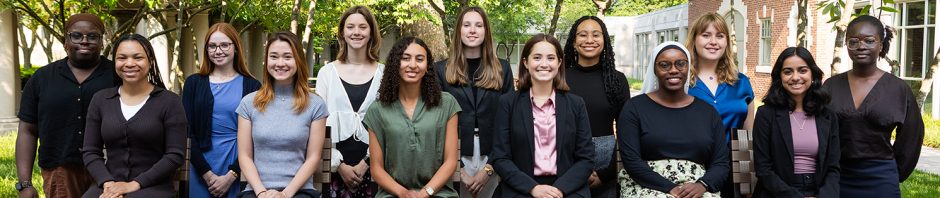
This past Wednesday the cohort had our first Fellow Learning Session at The Columbus Foundation. Our conversations centered on the theme of advocacy which stems from all social-issue-related nonprofit work. We had incredible speakers from the Juvenile Justice Coalition and The Children’s Defense Fund who started by talking about their work, but our conversation soon lead to much bigger questions about responsible allyship and effective advocacy.
All of this is to say, I have been thinking a lot about the intersections between being an impactful, mindful, and effective advocate while keeping a system thinking lens on approaches to solving social problems. We often talk about ‘tackling root causes’ of social issues (whether we remember it as often as we’d like to admit or not) and ensuring that we aren’t investing the majority of resources into ‘band-aid solutions’. This is often countered by the reality that people are starving, living on the street, and being abused right this moment – so – though systems change approaches are in theory the most effective, they operate on a different timeline than saving lives at this moment.
Systems change/root cause approaches are hard, and they take time. It is very difficult to convince humans to invest in anything that does not give a tangible short-term result. Even in the long term, these approaches are difficult to measure and it is uncertain to know what direction to go. Short-term and siloed solutions are much easier to measure. But we all know, feeding people alone won’t stop everyone from being hungry in the future.
This being said, we need both.
All of the work is necessary.
When talking with other cohort members after the enriching dialogue around being good stewards and thinking critically about big-picture thinking, many of us were left with some difficult questions…
“How do we start?”
“Where do we start?”
“When do we start?”
Because we are all also humans with flawed psychology it is hard to see the answers to these questions knowing that we could work our entire career and maybe not see major changes. And yet, that does not mean the work is not important. Some of the most critical work to be done is work of changing mindsets, cultures, and oppressive systems built over hundreds of years. This change we talk about may not be in the best interest of those with the money and power to invest in it.
I started thinking more specifically about the work we do at Besa. Often we are not doing advocacy work, we are not as an organization directly targeting food insecurity, homelessness, or incarceration. And so for a moment, I challenged myself to go back to the systems model and think critically about my personal vision of impact: one of aligned forces and finances, one of efficiency and maximized input to output ratios.
Besa does incredible work connecting more and more people to very important work in the community. Because of us, many community members find it much easier to volunteer, nonprofits find it easier to organize volunteers (in turn, having more capacity for other things), and (importantly) companies are able to connect with the community in a more direct way.
I think Besa’s greatest role in systems thinking social change is one of facilitation. We help the people with power (corporations with money) find easier ways to connect with nonprofits and track their own impact. Our hope, or my hope at least, is that by smoothing those bumps and facilitating relationships, we are incentivizing these companies to want to make philanthropy and community impact an even bigger priority. If we can make it easier for people to volunteer, companies to give grants, people to connect, then hopefully they do it more often.
In my opinion, the best way to make an impact is simple – first get educated, then get started. Be a knowledgeable advocate and culture changer for those around you. Find your mission, know your vision, and follow it. Know where your values lie, then be able to articulate them (even without speaking) to anyone around you.
And through all of this, it is still worthwhile to stay dedicated to the big picture. One of my favorite quotes that is attributed to many sources (but most famously spoken by Reverend Dr. Martin Luther King Jr.) is that
“The arc of the moral universe is long, but it bends toward justice”
which is the core driving principle of my reckless optimism. Believing that because of our determination to advocate for an equitable, humanistic, just society, every action of ours is not only important, but critical, and is not wasted no matter how things may seem.
 Columbus Foundation Fellowship Programs
I really enjoyed this. the message from Dr. King is an important reminder that I need with all that is going on in this country today. it gives me hope. And seeing what young people care about also gives me hope.