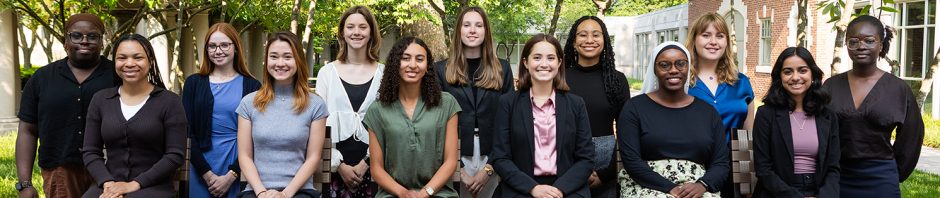
This week, we welcomed the new 2018-2019 service year AmeriCorps members! Needless to say, it has been a busy week at City Year. It has been exciting to witness City Year Columbus corps members at the very end AND the very beginning of their journey.
This week, we facilitated an orientation day for the new AmeriCorps members. Two pieces of the orientation stood out to me as ways in which organizational culture and values were communicated to incoming AmeriCorps members:
First, the staff of City Year Columbus introduced themselves to the corps using their preferred pronouns, and gave a short introduction to their role at City Year. City Year culture and curriculum centers itself around social justice issues and inclusiveness; the first workplace that I have ever experienced with such a focus. I thought it was incredibly important to begin to cultivate the conversation of identity and set the expectation of open, inclusive discussion at orientation. Each AmeriCorps member was also invited to introduce themselves with their pronouns as well. Not only did I think that this way of introducing everyone to each-other was a wonderful way to create an inclusive space for sharing, but that it opened up a dialogue about how to approach people who have identities different than your own. City Year staff encouraged AmeriCorps members to continue to introduce themselves with their preferred pronouns for the next few days of orientation as the corps gets to know one another, to ensure that each member was comfortable and aware of all preferred pronouns. I believe that this practice, although a small part of orientation, speaks to the way which City Year will operate during the new AmeriCorps’ member’s year of service.
The second part of orientation which was impactful to me was the telling of the “Beloved Community” story. Although we discuss the idea of the beloved community often at City Year, this was my first time hearing the story itself explained. The idea of the beloved community is central to City Year’s philosophy, and gives context to the type of communities that City Year hopes to help foster. The idea of the beloved community originated with Dr. Martin Luther King, Jr:
“Among Dr. King’s most compelling visions is that of a Beloved Community – a community in which people of different backgrounds recognize that we are all interconnected and that our individual well-being is inextricably linked to the well-being of others. Dr. King knew that the goal of social change is not tolerance alone, or even the recognition or enforcement of human or civil rights, or an improved economic condition. These are necessary but not sufficient steps in the path to human progress. We cannot rest until we have bridged the divides of prejudice and mistrust that lie within the human head and heart. Invariably, these final, resilient divisions are social and personal. Dr. King reminds us that reconciliation is a both a process and a final destination. The road to the Beloved Community is the difficult road of reconciliation among people who have been in conflict and negotiation. The Beloved Community is reconciliation achieved – a profound human connectedness, a transcendent harmony and love among all people.”
In Dr. King’s own words, the beloved community is described often as a place of inclusiveness, acceptance, and above all, kindness to one another:
“Desegregation is only a partial, though necessary, step toward
the ultimate goal which we seek to realize. Desegregation will
break down legal barriers, and bring men together physically.
But something must happen so as to touch the hearts and
souls of men that they will come together, not because the law
says it, but because it is natural and right. In other words, our
ultimate goal is integration which is genuine intergroup and
interpersonal living.
Only through nonviolence can this goal be attained, for the
aftermath of nonviolence is reconciliation and the creation of
the beloved community.
– Dr. Martin Luther King, Jr., 1958
I do not think of political power as an end. Neither do I think
of economic power as an end. They are ingredients in the
objective that we seek in life. And I think that end or that
objective is a truly brotherly society, the creation of the beloved
community.
– Dr. Martin Luther King, Jr., July 13, 1966
The end is reconciliation; the end is redemption;
the end is the creation of the beloved community.”
– Dr. Martin Luther King, Jr., December 3, 1956
This week, I am reminded of how fortunate I am to experience a workplace with people from so many different walks of life, and to work with an organization which values diversity so deeply. I am excited to begin the City Year journey with the incoming AmeriCorps members as they start off their training!
 Columbus Foundation Fellowship Programs